How to Define a Behavioral Health Brand Position That Patients, Families, and Referral Partners Trust
Behavioral health branding that patients, families, and referral partners trust starts with one provable position, then holds up on every admissions call.
Key Takeaways
- A brand position is the specific, provable reason a defined audience should choose your facility. A tagline does not do that job.
- Behavioral health branding has to work for three audiences at once: patients, families, and referral partners. Each one evaluates trust differently.
- Build one core position and translate it for each audience. Separate messages for each group tend to drift apart and create mixed signals.
- Compliance rules limit outcome claims, so trust comes from specifics: who you treat, how care works, and what happens after the first call.
- The admissions process is where a position holds or breaks. A website promise that intake cannot deliver costs admits and referral relationships.
Look across treatment center websites and the same descriptions appear again and again: evidence-based care, compassionate staff, and a full continuum of services. A person who calls three facilities in one night may hear three versions of the same pitch. Often, they choose the one that answered first.
That pattern points to a positioning gap, and it shows up in admissions data. Without a meaningful point of difference, admissions teams often end up competing on insurance acceptance, availability, and how quickly they answer the phone.
Good positioning gives them something more substantive to work with before that conversation even starts. A clear position gives the caller, the family, and the referring clinician a reason to choose your facility before the phone rings.
The need is large. In 2024, about 48.4 million people aged 12 or older met the criteria for a substance use disorder 1. Every facility competes for a share of that need, and the decision to enter care rarely belongs to one person.
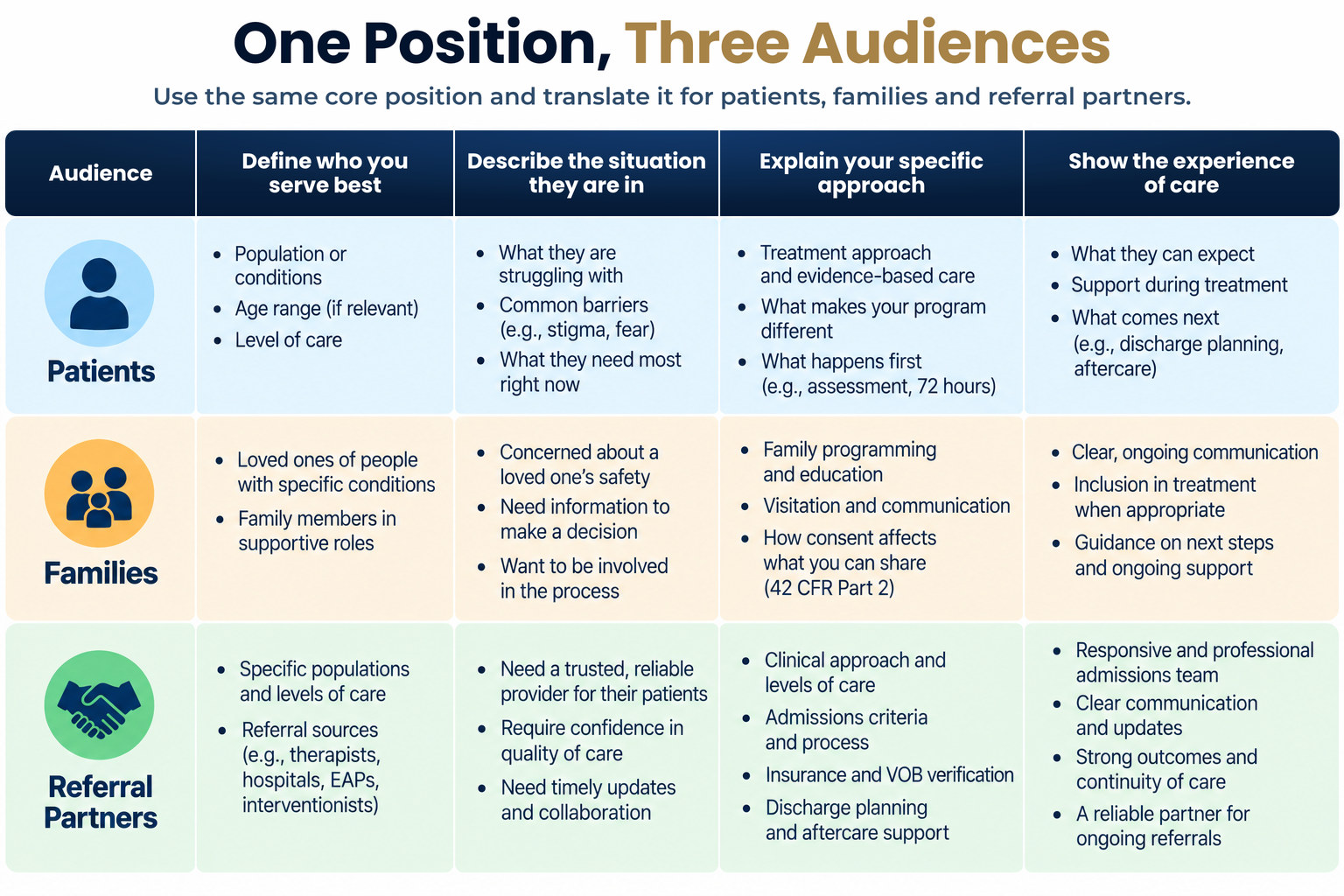
This article covers how to approach behavioral health branding around three audiences. It explains what each audience needs to believe, how to build one position that holds for all three, and how to test that position in the admissions process.
Why Most Behavioral Health Brands Sound the Same
Compliance narrows the available language. Facilities cannot promise outcomes, guarantee recovery, or make unsupported superlative claims. Google Ads policies and LegitScript certification add more limits on what paid media can say. Many facilities respond by retreating to safe, generic phrases.
Generic language has a cost at intake. When nothing separates one facility from the next, callers compare on the few variables they can see: insurance, bed availability, and response time. The admissions team is solely responsible for conversion, with no support from the brand.
A brand position solves a different problem than a tagline or logo. It defines who you serve best, what you do differently, and the proof that supports it. Every page, ad, call script, and referral conversation should trace back to it.
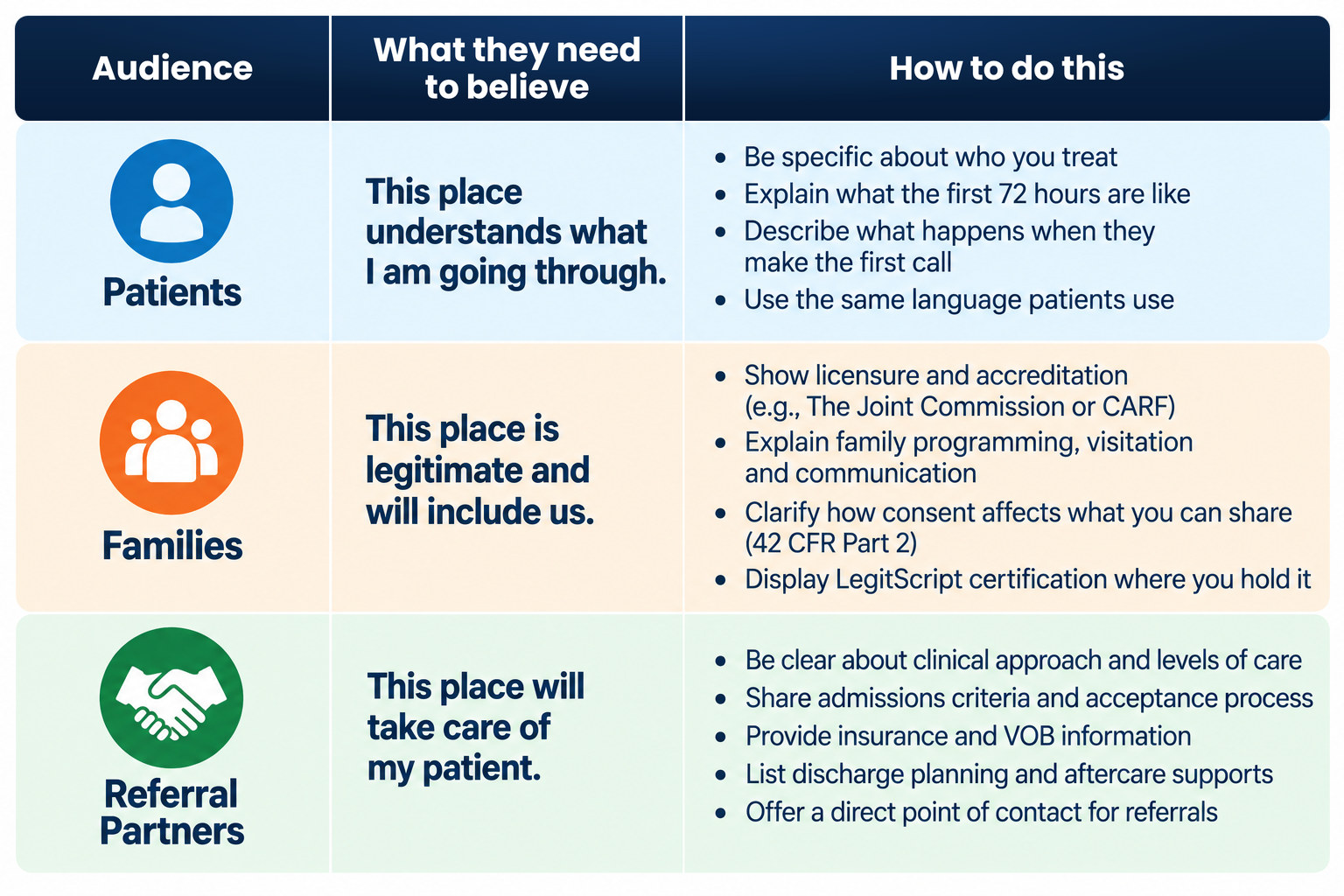
The Three Audiences and What Each Needs to Believe
Patients, families, and referral partners all influence the decision to admit. They arrive with different fears and different standards of proof.
Patients: This Place Understands What I Am Going Through
For the person who needs care, the first barrier is often just making that first call. Stigma often factors into the reasons people who need help do not seek care 2. A strong position lowers the emotional cost of that first call.
Being specific helps here. A prospective patient should be able to see who the program treats, what the first 72 hours are likely to involve, and what will happen when they make the first call. The language should also reflect how patients describe their situation themselves rather than defaulting to clinical shorthand.
Families: This Place Is Legitimate and Will Include Us
Families often research late at night, compare several facilities, and make the first call themselves. They want proof of legitimacy and a clear role in the process. SAMHSA notes that involving family members in substance use disorder treatment can positively affect client engagement, retention, and outcomes 3.
Families should be able to find concrete information about family programming, visitation, and communication before they call. It is also worth explaining how consent affects communication, since 42 CFR Part 2 limits what the facility can share without it. Display licensure, accreditation such as The Joint Commission or CARF, and LegitScript certification where you hold them.
Referral Partners: This Place Will Take Care of My Patient
Therapists, hospital case managers, EAPs, and interventionists stake their reputation on every referral. They judge a facility by experience, not marketing. One slow response or one poor handoff can end a referral relationship.
Referral partners need operational clarity. Referral partners need to know who the program can accept, how quickly they will get a response, and what happens when someone is not a clinical fit. Referring an inappropriate caller elsewhere can build more credibility than trying to force the admission. When consent allows it, closing the loop after admission and discharge matters too.
How to Build One Position That Holds for All Three
The goal is to build one position and translate it for the three audiences, rather than developing separate messages that gradually drift apart. As a working exercise, try completing: for [population] who [situation], [facility] provides [specific approach] so that [experience of care]. Don’t treat the result as finished website copy; use it to force clarity about your position.
The following table includes suggestions of how to do this:
| Define who you serve best. | Narrow the clinical populations, levels of care, and payer mix where your program performs most consistently. A narrow focus gives the position credibility. |
| Name what you do differently. | Choose one or two program features that competitors in your market do not offer in the same way. |
| Attach proof to every claim. | Proof means program structure, staff credentials, accreditation, schedules, and process details. It does not mean outcome promises. |
| Write one core statement. | Use a simple frame: for [population] who [situation], [facility] provides [specific approach] so that [experience of care]. |
| Translate it for each audience. | Keep the core fixed and change the emphasis, the proof points, and the channel. |
| Review it for compliance before it ships. | Check every version against LegitScript standards, Google healthcare ad policies, and FTC rules on claims. |
That same position answers a different question for each audience. The patient can immediately see whether treatment might fit around work. The family knows there is a role for them in the program, while a referring therapist has enough clinical specificity to judge whether the program fits a particular client.
Where Brand Positions Break: The Admissions Process
The intake call is the brand. Neither a caller nor a referral partner separates the website from the person who answers the phone.
The disconnect is usually easy to spot once you look for it. A website may emphasize family involvement even though the coordinator cannot explain the family program. An ad offering immediate help loses credibility when the after-hours call goes to voicemail. Referral partners notice the same gap when they’re promised a fast response and the VOB takes a full day.
Audit the admissions process against the position at these points:
- Speed to lead across calls, forms, and chat, including nights and weekends.
- Call scripts that reflect the position in plain language.
- VOB turnaround and how coordinators explain benefits to callers and families.
- The handoff from admissions to clinical staff on admission day.
- The referral-back process for callers who are not a clinical fit.
- Follow-up with families and referral partners after first contact.
Train coordinators on the position, not just the script. Score call recordings against it. Track intake-to-admit rate by lead source, repeat referrals by partner, and the share of calls that ask for the facility by name. These signals show whether the position reaches the people making the decision.
The Census: The elev8 Newsletter
Join 2,000+ behavioral health leaders. Get notified when we publish new articles — the strategies, data, and insights shaping behavioral health marketing.
2,000+ executives already subscribed
Unsubscribe anytime. Just one newsletter a month — no spam.
Conclusion
A behavioral health brand position earns trust when it is specific, provable, and consistent across every audience. A useful brand position should make the admissions team’s job easier. It gives prospective patients a clearer sense of whether the program understands their situation, helps families know what to expect, and gives referral partners enough information to decide whether the facility is a good clinical fit.
That position has to survive contact with the actual admissions process. If the website promises immediate support but calls go unanswered, or family involvement is emphasized but nobody can explain how it works, the brand promise has little value.
Start with a position the facility can prove, then test it in calls, VOBs, referrals, and admissions. What people experience after they make contact matters more than what the tagline says.
Test Our Website Assessment Tool
Try the tool now to gauge your AI visibility, Core Web Vitals, HIPAA compliance, security, and overall performance.
Sources
- Substance Abuse and Mental Health Services Administration. (2025). Key substance use and mental health indicators in the United States: Results from the 2024 National Survey on Drug Use and Health. Center for Behavioral Health Statistics and Quality.
- National Institute on Drug Abuse. (n.d.). Stigma and discrimination. National Institutes of Health.
- Substance Abuse and Mental Health Services Administration. (2021). The importance of family therapy in substance use disorder treatment (Advisory, Publication No. PEP20-02-02-016).

Founder & CEO · elev8.io
Gary Garth is the Founder & CEO of elev8.io, where he helps behavioral health organizations achieve full census through integrated marketing, admissions, and technology-driven growth systems.
With more than a decade of experience working alongside Google, Microsoft, and high-growth technology companies, Gary has built and implemented scalable growth frameworks now used by 45+ treatment centers across the United States to drive admissions and operational efficiency.
As a speaker, Gary focuses on the intersection of patient acquisition, AI-driven search, and admissions performance, helping founders, operators, and investors identify the hidden bottlenecks limiting growth—and how to fix them.
The author of The Zero to 100 Million Sales Blueprint and The Goals, Grit & Greatness Planner™, Gary is driven by a mission to close the gap between the millions of people struggling with addiction and mental health and the care they need.
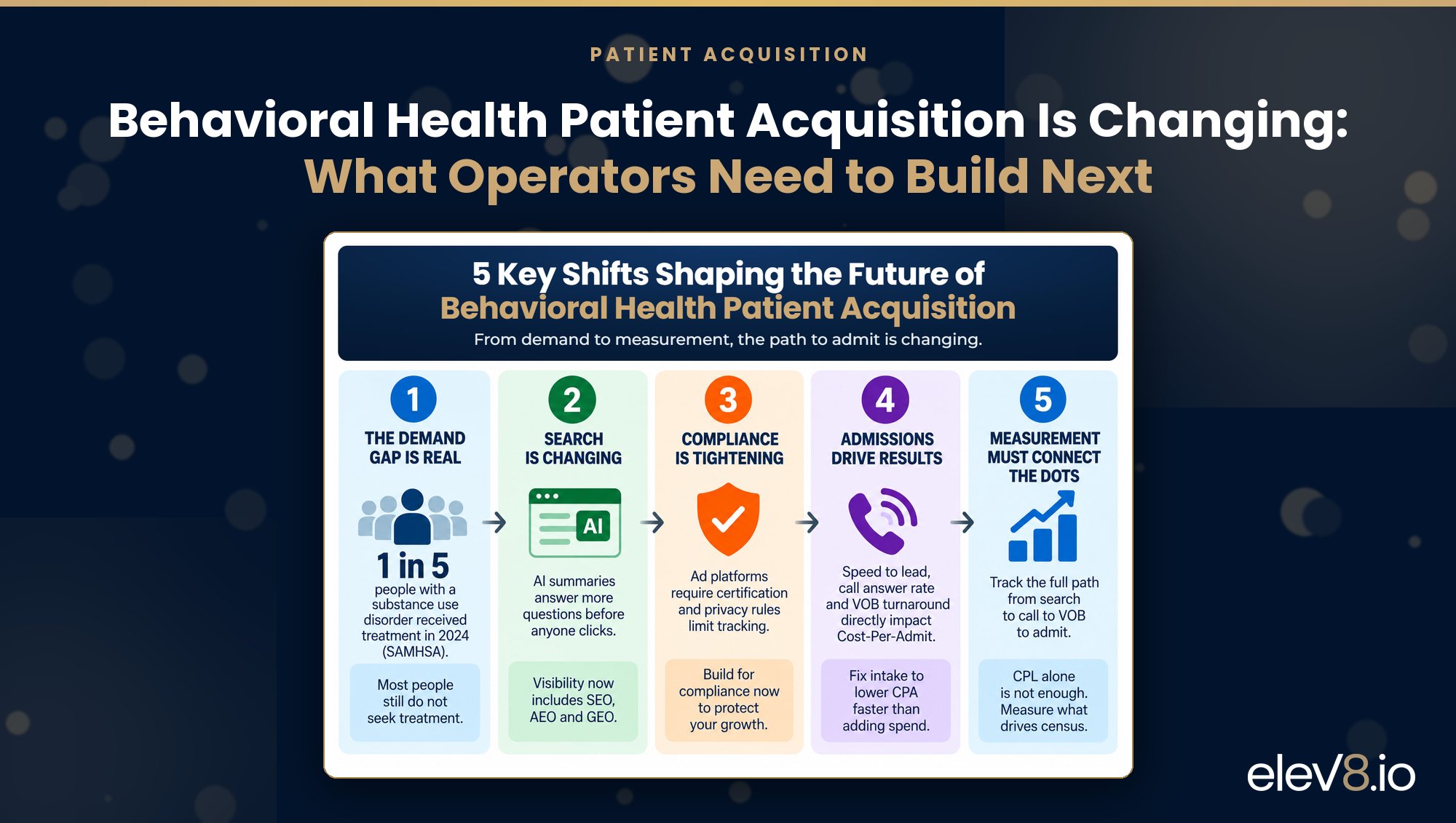
Behavioral Health Patient Acquisition Is Changing: What Operators Need to Build Next
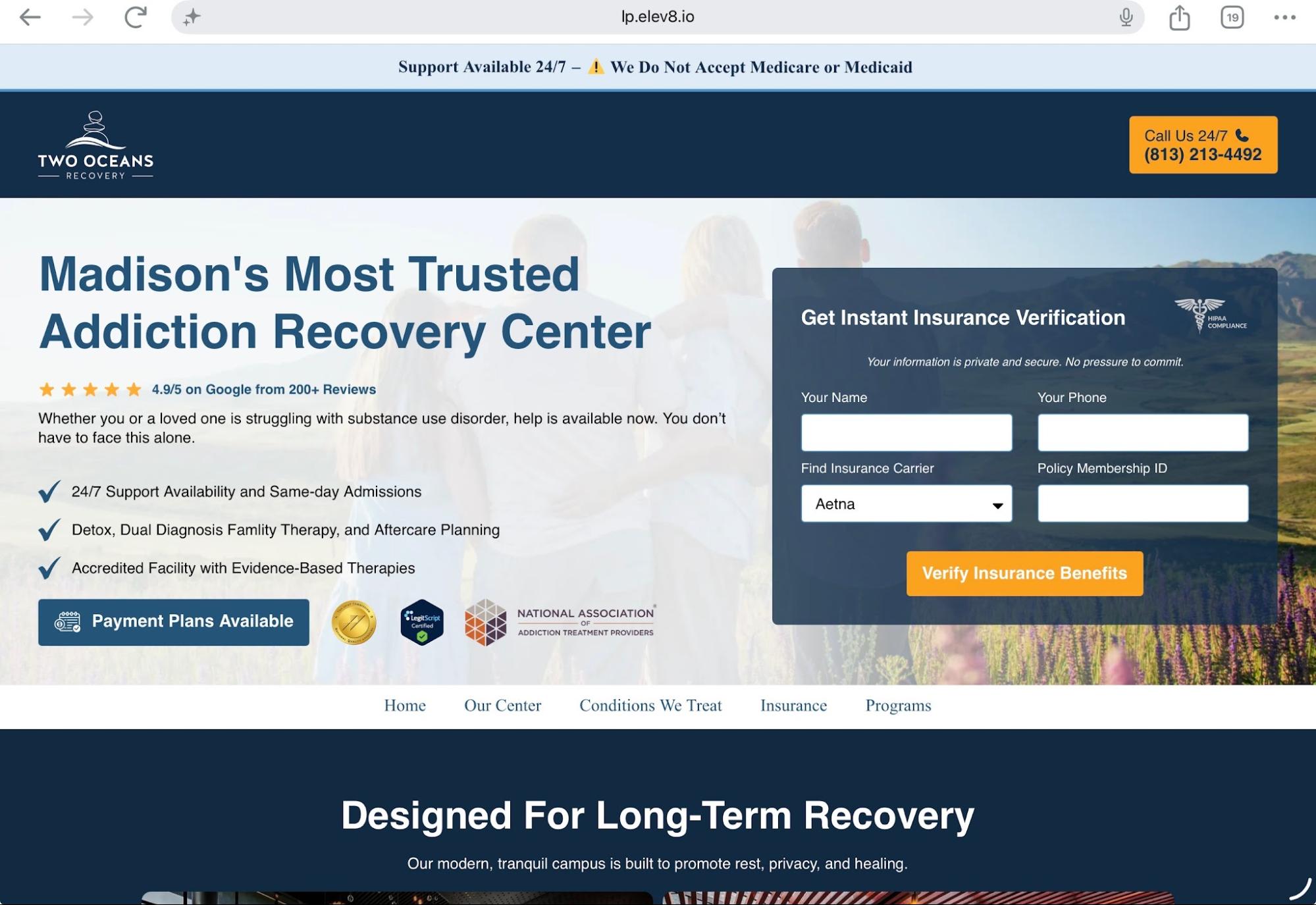
From Fear to First Call: How to Build a High-Converting, VOB-Optimized Landing Page